We have been keeping up-to-date with information on the developments around the globe that have a bearing on health and wellbeing, lives and livelihoods etc during these difficult times by various news publishers, broadcasting and webcasting channels. At the same time, fake news is now viewed as one of the greatest threats to democracy, journalism, and freedom of expression. The explosive growth in fake news and its erosion to democracy, justice, and public trust has increased the demand for fake news. Humans have been proven to be irrational and vulnerable when differentiating between truth and falsehood. Social and psychological factors play an important role in fake news gaining public trust and further facilitate the spread of fake news.
Fake news, also known as junk news, pseudo-news, alternative facts or hoax news, is a form of news consisting of deliberate disinformation or hoaxes spread via traditional news media (print and broadcast) or online social media. Digital news has brought back and increased the usage of fake news. Fake news is written and published usually with the intent to mislead in order to damage an agency, entity, or person, and/or gain financially or politically, often using sensationalist, dishonest, or outright fabricated headlines to increase readership. Similarly, clickbait stories and headlines earn advertising revenue from this activity.
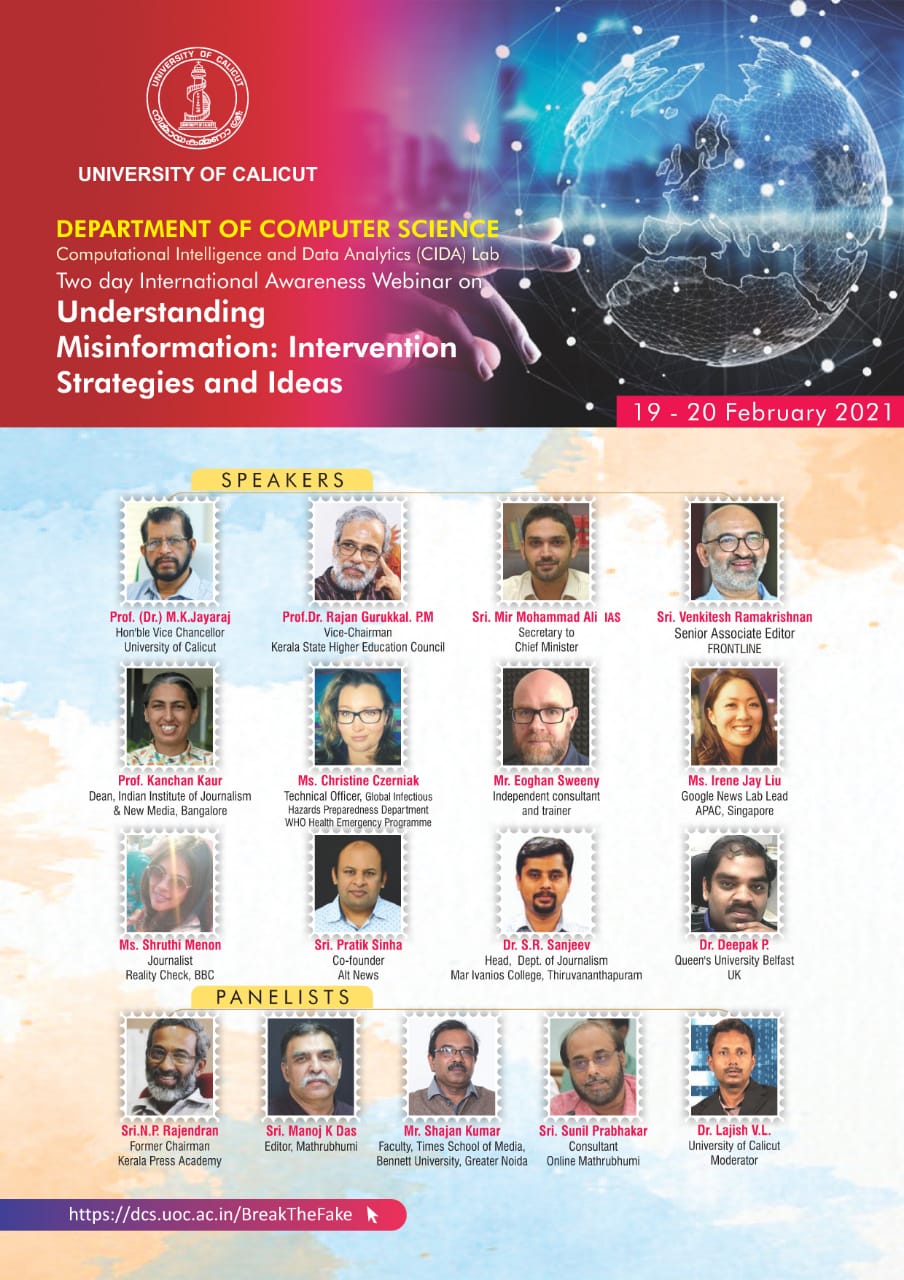
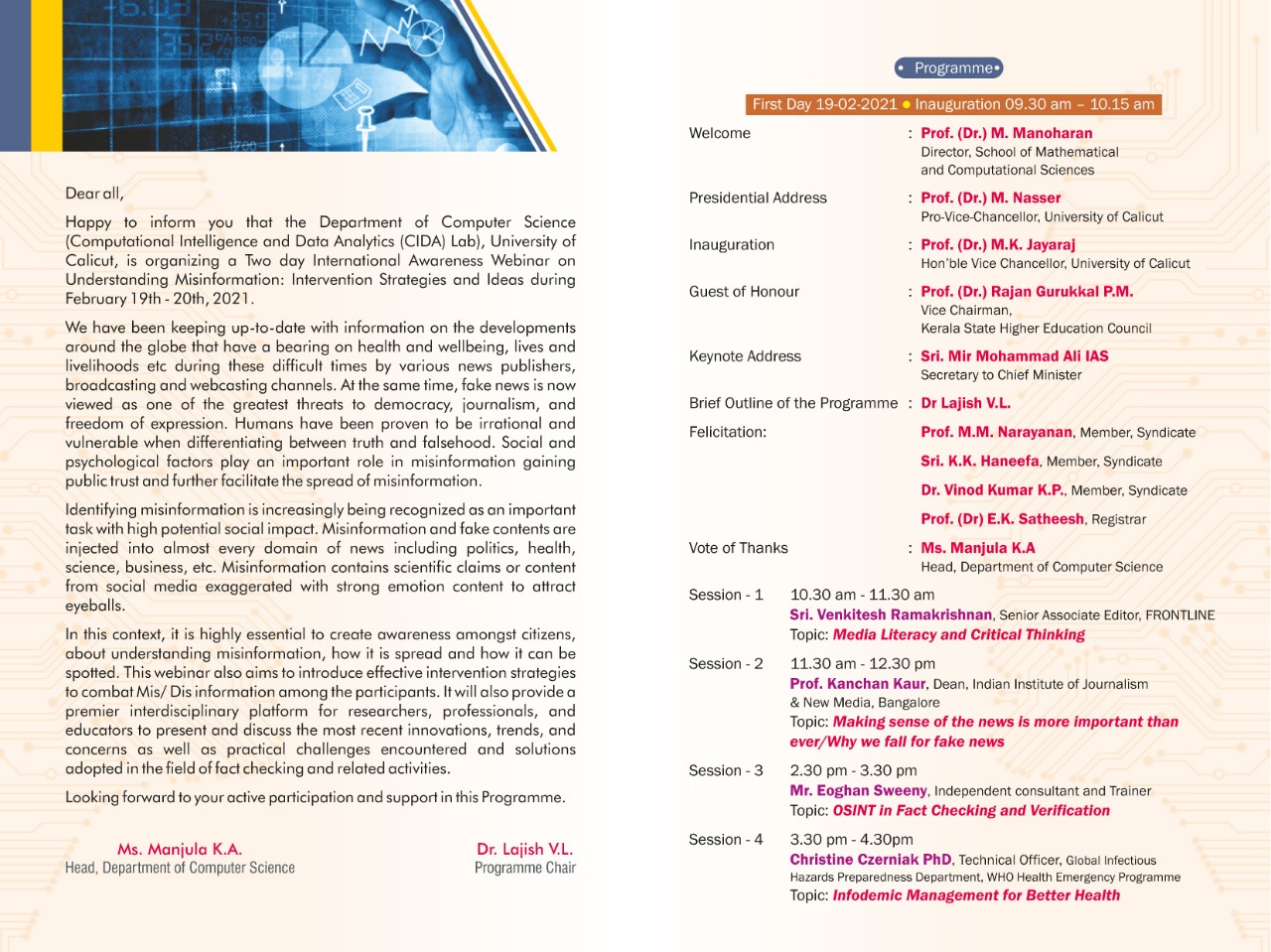
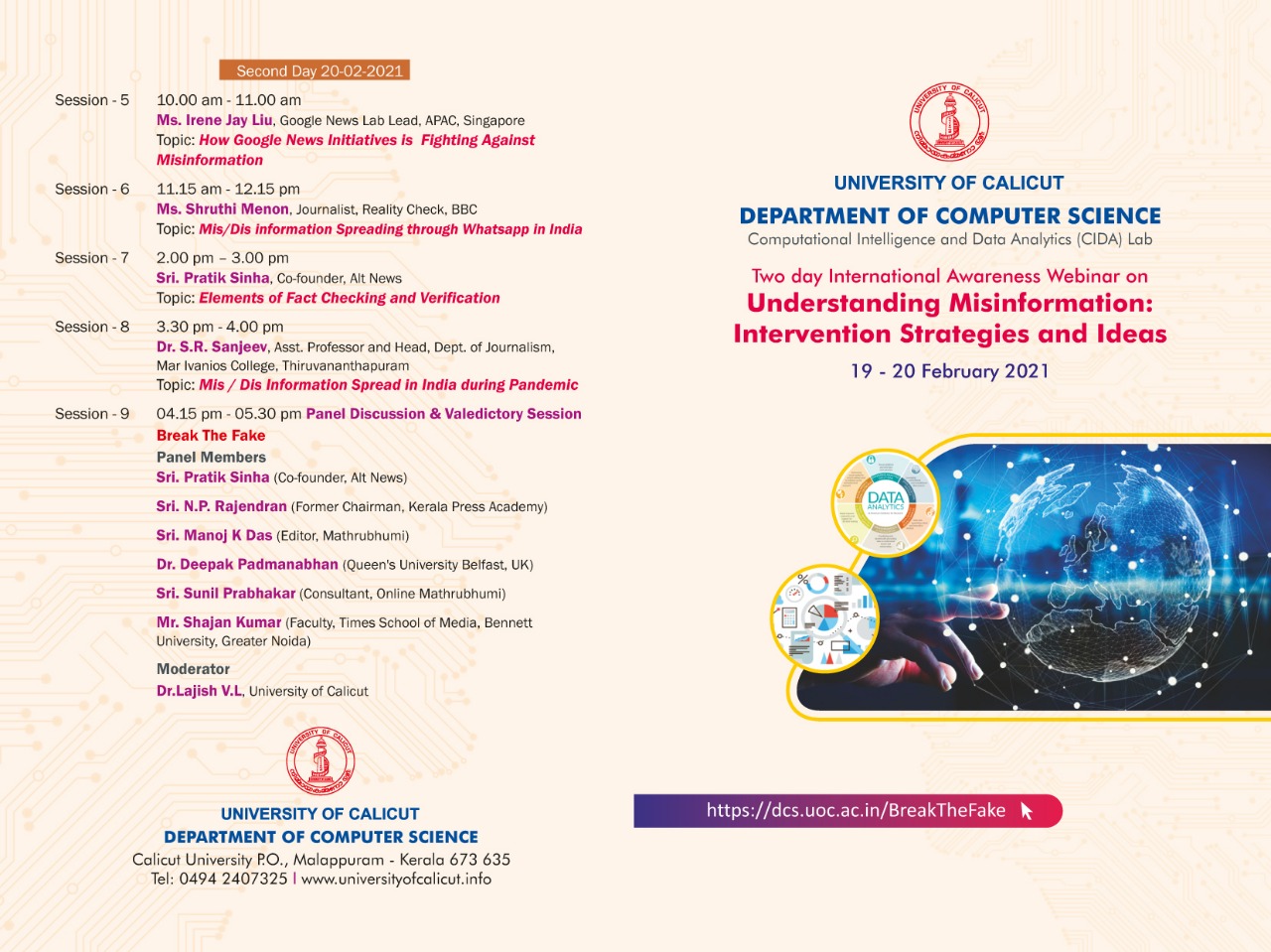
Identifying misinformation is increasingly being recognized as an important task with high potential social impact. Misinformation and fake contents are injected into almost every domain of news including politics, health, science, business, etc., among which, the fakeness in the health domain poses serious adverse effects to scare or harm the society. Misinformation contains scientific claims or content from social media exaggerated with strong emotion content to attract eyeballs. In this context, it is highly essential to create fake news awareness amongst citizens, to educate them about what it is, how it is spread and how it can be spotted.This international awareness webinar also aims to introduce effective intervention strategies to combat fake news among the participants.
At the end of this awareness programme, the participants will be able to understand
What is fake news, sources of fake news, how it is spread and how it can be spotted.
Prevalence and impact of fake news
Effective Methods for Combating Fake News
Media Literacy and Critical Thinking
Understanding Information
Various Types of Information
Sources of Information/ Information overload
News and Information
Traditional Media vs New Media
Misinformation and Disinformation
Types of Mis / Dis Information
Dangers of Mis / Disinformation
Authenticity of Information
Analysing Sources of Information
Recognize what the media maker wants us to believe or do
Recognize bias, spin, misinformation and lies
Media Literacy through Critical Thinking
Verifying Text, Images and Videos
Verifying Accounts
Verifying Locations
Fact Checking Resources
Social media and Misinformation
Elements of Open Source Intelligence
Meeting the Challenges of Digital Citizenship
Automatic Fact-checking
What is news and who decides?
Where can we find trustworthy information?
Says who?
How do I apply news literacy skills?
Meeting the challenges of digital citizenship
What is Fake News?
Fundamental Theories, Detection Methods, and Opportunities
The Psychology of Fake News - post truth
How Fake News Spreads
Intervention strategies
Encourage users - Fact checking, Encourage Exposure to Refutations,
Teach how to identify fake news, Reduce Exposure to Fake News Reduce Propagation
Data science in the era of fake news
University/College faculty members, Graduate/ Postgraduate/ Research students and professionals
Two days
University of Calicut is the largest University in Kerala. Established in the year 1968, it is the second university to be set up in Kerala. The University aims to nurture excellence in education and research in its catchment areas of Northern Kerala, historically consigned to the periphery of Kerala’s academic map. The University lays its emphasis on fostering quality human resource and promoting productive research that benefit both local communities and wider humanity.The University was created through a Government plan bifurcating Kerala University. As per the plan, the four post-graduate departments of the University of Kerala operating in Calicut were annexed to the new University along with fifty four constituent colleges spread across seven northern districts. With ‘Nirmaya Karmana Sree’ as it motto, the University has been able to surmount all challenges and emerge as the largest residential cum affiliating University in Kerala. With 30 post graduate departments and 426 colleges it has become a beacon of hope and enlightenment for hundreds of thousands of young men and women in North Kerala.
Computer-based technologies are the foundation of modern life and as a University Department we are proficient to contribute towards the advancement of the society at large. We also ensure our sincere effort to offer the best in terms of Academic programmes, Research activities and infrastructure including State-of-the-art laboratories. The Department with the bright young and dynamic faculty members attracts the best of students for its masters and doctoral programmes. We also aim at bringing in excellent opportunities for active institute-industry interaction and exchange programmes which will unquestionably help the students to excel in the present competitive professional life.
Our vision is to create a vibrant learning environment founded on value based academic principles that foster collaboration, a culture of accomplishment and strong support of ethnic and intellectual diversity wherein all involved shall contribute effectively, efficiently and responsibly
Highest quality Post Graduate and Doctoral education as per international standards.
State-of-the-art research facilities with the upgraded laboratory facilities time to time.
Strong partnerships with industries, government agencies, professional societies and local communities.
Extension and consultancy services to government, private, public and industrial sectors



0494-240 7325
+91-94957 93094
Dr. Lajish V. L (Programme Chair) Assistant Professor, Department of Computer Science & Director, Computer Centre University of Calicut, Kerala, India 673635
cidalab@uoc.ac.in